FileMaker Co-Working Agents Need Business Boundaries
Codex and Claude-style agents are most useful around FileMaker when they are tailored to real workflows, review queues, approval rules, and source-of-truth data.
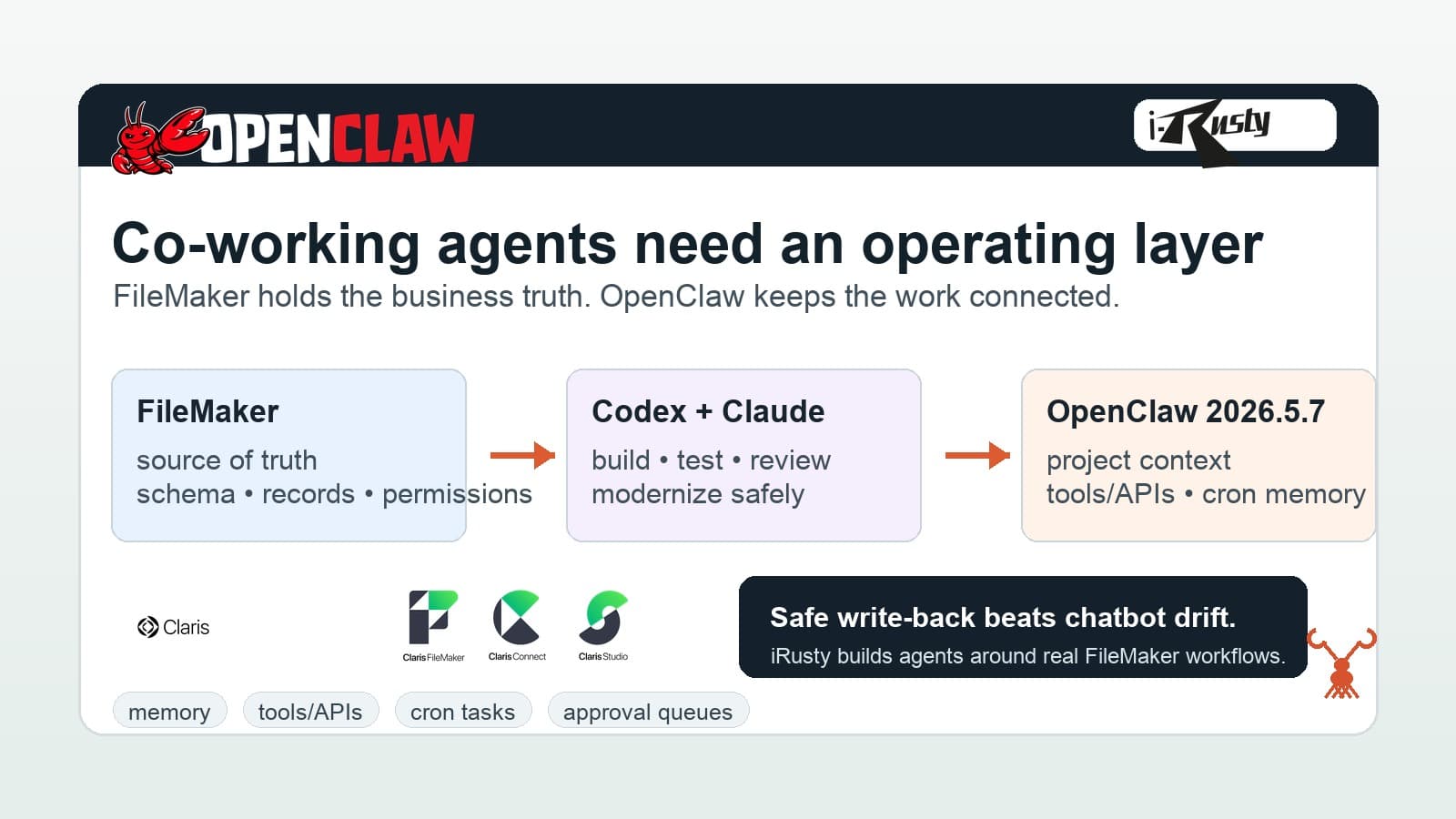
The future is not one generic chatbot
The useful pattern emerging from OpenAI Codex, Claude Code, and other co-working agent workflows is not a single chatbot answering random questions. It is a set of tailored agents that know the job they are allowed to do.
For a FileMaker business, that distinction matters. FileMaker already holds the operating truth: customers, orders, jobs, approvals, scripts, layouts, reports, permissions, and the messy edge cases that keep the company moving.
Give each agent a bounded job
A practical FileMaker agent should have a narrow responsibility: review overdue work, draft exception notes, compare a proposed script change against the schema, prepare a modernization checklist, reconcile imported orders, or summarize records that need human approval.
Codex-style agents are strong at reasoning through code, tests, scripts, and implementation details. Claude-style agents are useful for review, drafting, explanation, and second-pass judgment. Neither should be treated as the database of record.
FileMaker remains the source of truth
The safest architecture is simple: FileMaker keeps the trusted records and business rules. The agent layer reads from that truth, drafts useful work, explains its reasoning, and hands decisions back through review queues and approval logs.
OpenClaw-style operating layers help because they keep the supporting pieces connected: memory, tools, schedules, approvals, review queues, and follow-through. The point is not insider agent jargon. The point is making sure the work does not vanish between prompts or bypass the people who own the process.
Start where the business already feels pain
The best first co-working agent is usually not glamorous. It is the daily exception reviewer, the report cleanup assistant, the stale-follow-up checker, the approval queue preparer, or the FileMaker modernization auditor.
Those agents can save real time because they sit beside a workflow the business already trusts. They do not ask employees to abandon FileMaker. They make the existing system easier to inspect, improve, and act on.
The buying decision should be workflow-first
Businesses should not start by asking which generic chatbot to buy. They should ask which repeatable workflow deserves a custom co-worker: what it can read, what it can draft, who reviews it, what gets logged, and what is allowed to write back.
That is the iRusty lane: build FileMaker-aware agents around real operating workflows, with the database still in charge and humans still able to see why a decision is being proposed.
If your FileMaker system has one workflow that always needs review, cleanup, reporting, or approval, iRusty can help turn it into a practical co-working agent.
Talk to iRusty